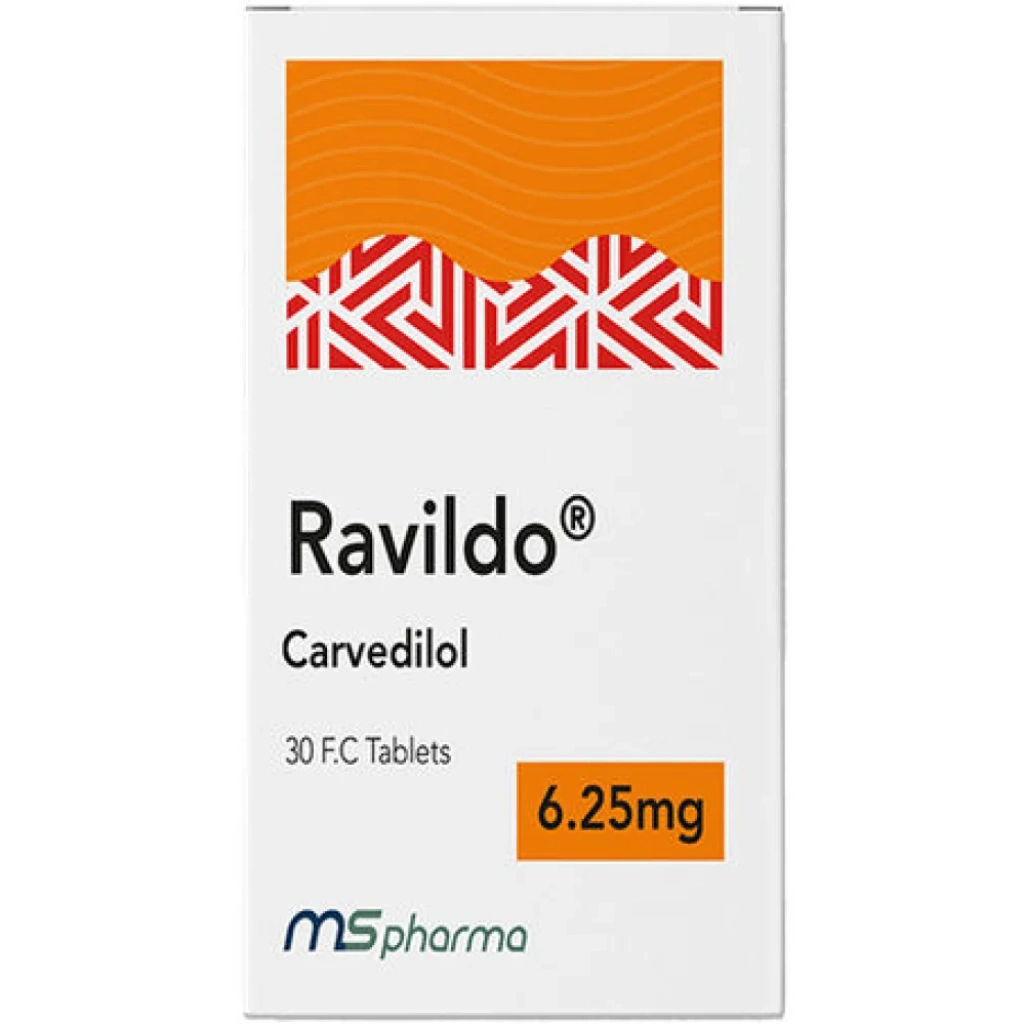
Product Description:
Rivaldo (Carvedilol) is a multi-action adrenergic receptor blocker with α1, β1, and β2 adrenergic receptor blocking properties.
Carvedilol has been shown to have organ-protective effects.
Carvedilol inhibits the renin-angiotensin-aldosterone system through β-blockade, which reduces renin secretion, making fluid retention rare.
Carvedilol reduces peripheral vascular resistance through selective blockade of alpha-1 receptors.
Carvedilol has no negative effect on the lipid profile. The normal ratio of high-density lipoproteins to low-density lipoproteins (HDL/LDL) is maintained.
Properties:
Absorption: Carvedilol is rapidly absorbed after oral administration. Peak plasma concentration is reached after approximately one to two hours. There is significant first-pass metabolism, and absolute bioavailability is about 25% (12-49%).
Distribution: The steady-state volume of distribution (VDss) is approximately 2 L/kg. Carvedilol is 98% bound to plasma proteins.
Metabolism: Carvedilol is almost entirely broken down into compounds that are primarily eliminated via the biliary route. Carvedilol is mainly metabolized in the liver.
Elimination: The half-life of carvedilol after oral administration is about 6-10 hours. Plasma clearance is 590 ml/min. Elimination is predominantly biliary. The primary route of elimination is via feces. Less than 2% of the unchanged substance is eliminated via urine, and about 15% in the form of metabolites.
Indications:
Rivaldo is used in the following cases:
- Treatment of essential hypertension (mild to moderate) and chronic angina pectoris for the prevention of attacks.
- Treatment of mild to severe stable heart failure (NYHA class II-IV) due to ischemic cardiomyopathy as an adjunct to standard therapy (diuretics, digoxin, ACE inhibitors).
Instructions for Use:
Essential Hypertension:
Adults: The initial dose of Raveldo is 12.5 mg once daily for the first two days. Thereafter, a dose of 25 mg once daily is recommended. If the effect is insufficient, the daily dose may be increased after at least two weeks to 50 mg taken as a single or two divided doses of Rivaldo. The maximum daily dose for hypertension is 50 mg.
Elderly Patients: Initially, a dose of 12.5 mg of Raveldo is given once daily. In some patients, this dose is sufficient for adequate blood pressure control. If the effect is insufficient, the daily dose may be gradually increased at intervals of at least two weeks to a maximum of 50 mg taken as a single or two individual doses.
Angina Pectoris:
The initial dose of Raveldo is 12.5 mg twice daily for the first two days. Thereafter, a dose of 25 mg twice daily is recommended. If the effect is insufficient, the dose may be gradually increased at intervals of at least two weeks up to a maximum daily dose of 100 mg taken in two individual doses.
Elderly Patients: Generally, a dose of 25 mg of Raveldo twice daily should not be exceeded.
Treatment of Severe Mild Heart Failure (NYHA class II-IV):
The dose of Rivaldo must be determined individually, and the patient must be closely monitored during titration. The dose of digitalis, diuretics, and ACE inhibitors must be stabilized before starting Rivaldo.
The recommended starting dose is 3.125 mg of Raveldo taken twice daily, then the dose is increased to 12.5 mg twice daily, then to 25 mg twice daily. The dose should be increased to the highest level tolerated by the patient.
The maximum recommended dose is 25 mg twice daily for patients weighing up to 85 kg and 50 mg twice daily for patients weighing more than 85 kg.
Before each dose increase, the physician should examine the patient for signs and symptoms of worsening heart failure, vasodilation (hypotension, dizziness), or bradycardia. Transient worsening of heart failure or fluid retention should be treated with increased doses of diuretics, although it may sometimes be necessary to reduce the dose of Raveldo or temporarily discontinue treatment.
If Raveldo treatment is interrupted for more than two weeks, it should be restarted at a dose of 3.125 mg; this dose should then be increased at two-week intervals as described above.
Signs and symptoms of vasodilation should initially be treated by reducing the diuretic dose. If they persist, the ACE inhibitor dose should be reduced, followed by a reduction in the Raveldo dose.
Under these circumstances, the Raveldo dose should not be increased until signs and symptoms of worsening heart failure or vasodilation improve.
The safety and efficacy of Raveldo in patients under 18 years of age have not been investigated.
Patients with Renal Impairment: No reduction in the initial dose is required for patients with renal impairment.
Patients with Hepatic Failure: Careful dose titration should be performed in cases of hepatic impairment.
Rivaldo tablets should be taken with a sufficient amount of liquid.
Patients with heart failure should take Raveldo tablets with food to slow the rate of absorption and reduce the incidence of orthostatic effects.
Treatment with Raveldo is generally a long-term therapy. It should not be stopped abruptly but should be tapered over several days (e.g., by halving the dose every three days); this is particularly important in patients who also have coronary artery disease.
Warnings and Precautions:
Contraindications:
- Hypersensitivity to the active substance or any of the excipients.
- Decompensated chronic heart failure (NYHA class II-IV) in patients requiring intravenous inotropic support.
- Chronic obstructive pulmonary disease (COPD).
- Bronchial asthma.
- Allergic rhinitis.
- Glottis edema.
- Cor pulmonale.
- Sick sinus syndrome.